Submit your details, Stay Informed & be eligible for a Scholarship up to 50%
Philips University Welcomes You to a New Student Experience!
At Philips University, the student is our driving force and the center of all our processes. This is why we are committed to providing quality education that meets the needs of modern society.
Philips University is a modern and innovative institution in the island of Cyprus, Europe. We offer high-quality teaching and research to the academic community, providing students today with the opportunity to become the leader of tomorrow.

Our recognitions


What is environmental sustainability?
According to the U.N. Environment Programme, environmental sustainability is the practice of interacting with the planet responsibility. We do it to avoid depleting natural resources and compromising the future generation’s ability to meet their daily needs and healthy lives, we need to live long and deserved unpolluted air to breath, clean water to drink, and live in places free of toxic substances.
In today’s competitive market, sustainability can become a critical profit centre for any organization such as energy savings, raw materials optimization and resources utilization.
In recent years, such as climate change, environmental degradation and gene/nanotechnologies have regularly highlighted the need to society to challenge and address risks and ethics in the sciences.
There is a growing evidence that companies take their environmental and social responsibilities seriously so as to perform better financially. All businesses, regardless of their location or industry can play a role in environmental sustainability, by re-shaping their activities to protect natural resources, reduce waste, and address threats from climate and weather.
For businesses, sustainability means running a business through sustainable practices and securing further growth potential without causing too much damage to the environment.
Finally, it is our job to ensure our future generations have healthy places to live and minimize our damage to earth’s biodiverse ecosystems.
The purpose of the programme is, to:
1. Provide a rigorous academic education leading to the MSc degree in Environmental Management with streams in one of the following areas:
• Sustainable Waste Management
• Environmental Management, Policy & Economics and Green Accounting
• Environment and Public Health
2. Provide students with a comprehensive understanding of the environmental issues that concern the current community, worldwide.
3. Develop a critical understanding of the importance of sustainable development to reduce the emissions to air, water and land.
4. Explore the exploitation of natural environments and the relationship between sustainable environmental management and natural ecosystems.
5. Meet the need for environmental professionals who understand the challenges of sustainable environmental management.
6. Offer a curriculum that maps out to the Cyprus Agency of Quality Assurance and Accreditation in Higher Education (CYQAA) academic benchmarks and yet aims to meet the accreditation requirements of:
• The Chartered Institution of Water Environmental Management (CIWEM), and
• The Institute of Environmental Management and Assessment (IEMA).
Duration
18 months
Qualification Awarded
MSc in Environmental Management
Level of Qualification
Postgraduate
Language of Instruction
English & Greek
Mode of Study
Distance Learning
Minimum ECTS Credits
90
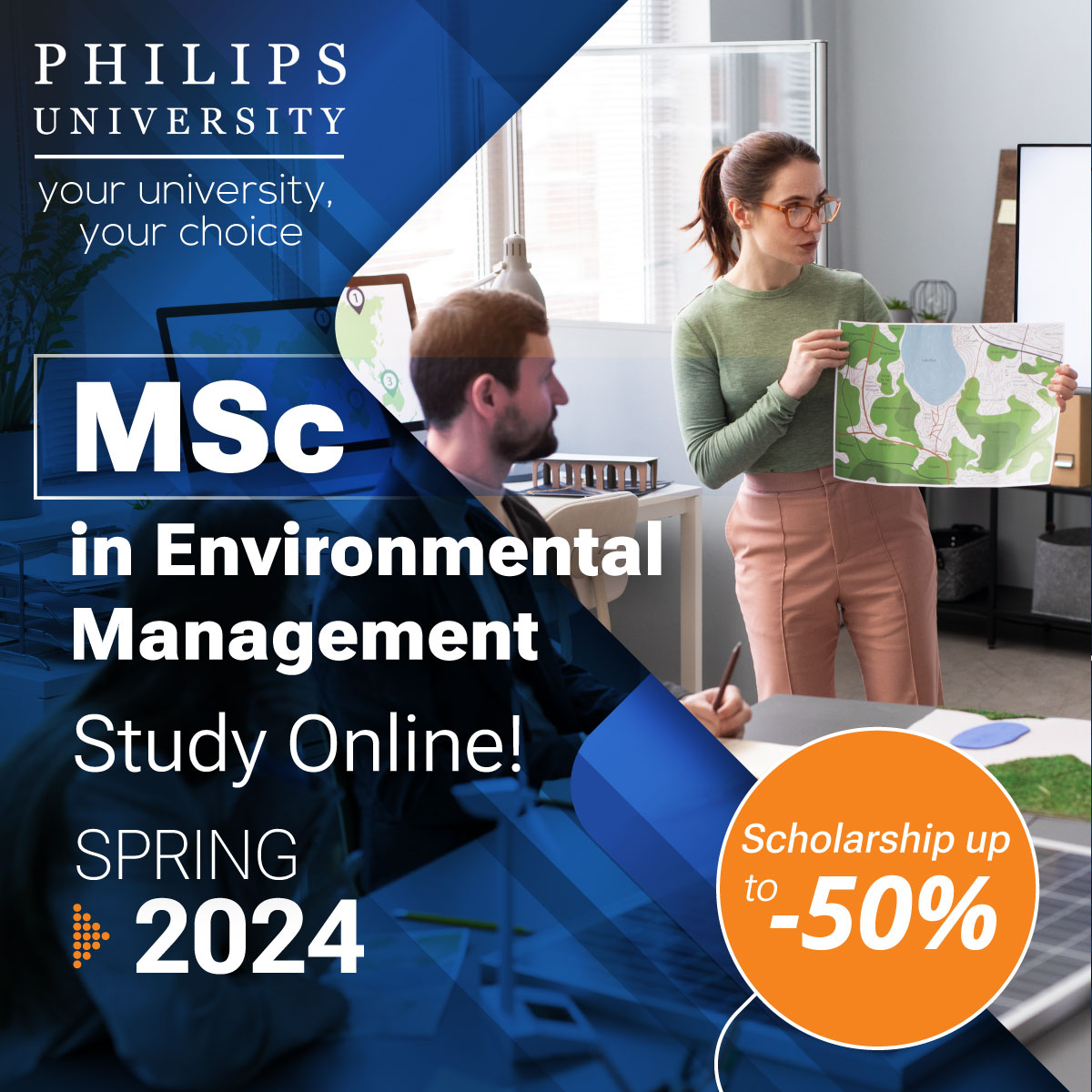
MSc in Environmental Management
Scholarship up to -50%!
10+ Reasons to Choose Philips University!